Attendee free offerThe AI ShortlistApply by Nov 15
← Evidence

AI · Independence

What is actually new about the forward deployed engineer

Four technology vendors committed about $9 billion in 2026 to placing engineers inside their customers. The role is mostly not new. Two things about it are.
Trusted advisorOctober 20269 min read
What is actually new about the forward deployed engineer

Key takeaways

  • Between May and July 2026, OpenAI, Anthropic, AWS and Microsoft committed about $9 billion to forward deployed engineering programs.
  • Being on site is the old part. Consultants have always embedded with clients, for the same reason: the knowledge a problem needs is stuck where the work happens.
  • Two things are new: a direct line into the product team, and a vendor paying for the placement.
  • To read any job with the title, ask two questions: can this person get the product changed, and who pays them?
  • History suggests the vendor-funded version is a phase. The function is permanent; the title probably isn't.
Between May and July 2026, four technology vendors committed about $9 billion to placing engineers inside their customers. On Indeed, job postings with the title went from 643 in April 2025 to 5,330 a year later. The role is mostly not new. Two things about it are.

One title, already stretched past breaking

OpenAI launched a Deployment Company with more than $4 billion. Anthropic and its investors put $1.5 billion behind a services venture. AWS committed $1 billion. Microsoft launched Frontier Company with $2.5 billion and about 6,000 people.
The title now covers very different jobs. At Palantir, which created it, the engineer writes production code inside a customer's environment. At a staffing firm, the same title describes someone building Copilot Studio agents and Power Platform solutions. On the Microsoft marketplace you can buy "FDE as a Service." Even Microsoft's Judson Althoff wrote that Frontier Company goes beyond what has been labeled forward deployed engineering.

Being on site is the old part

Most descriptions of the role start with the word "embedded." The engineer sits with the customer, learns the business, and builds in place.
Consultants have always done this. An ERP or CRM program puts people at the client for months or years. Some of AWS's forward deployed pods are designed to leave after 45 days, which is shorter than a typical enterprise discovery phase.
There is a well-known explanation for why this happens. In 1994, Eric von Hippel of MIT described some information as "sticky": costly to acquire, move, and use anywhere other than where it lives. When the knowledge a problem needs is stuck at one site, the problem-solving tends to move there. How a distributor really handles a backorder is sticky in exactly this sense. That is why consultants go on site, and it is why these engineers do too.
The mix of skills is familiar as well. One practitioner describes the job as three hats at once: consultant, product manager, and software engineer. Palantir originally split this across two people, an engineer it called a "Delta" and a domain expert it called an "Echo." A strong techno-functional consultant routinely carries both.

What is new

Two things separate the role, at its best, from conventional consulting.
The line into the product. When a consultant hits a software limitation, the options are workarounds, customization, or raising the issue with the vendor and waiting. Palantir describes its field engineers as working on one customer across many capabilities, while product engineers work on one capability across many customers. What the first group learns is meant to change what the second group builds. A consultant at a partner firm has no equivalent route.
The payer. Consultants are paid by the client, through a firm, for time spent. Forward deployed engineers are funded by the vendor. In one analysis of about 1,000 postings, 70% mentioned equity and none carried a sales quota. Their employer's interest is that the platform gets used, not that the engagement renews.
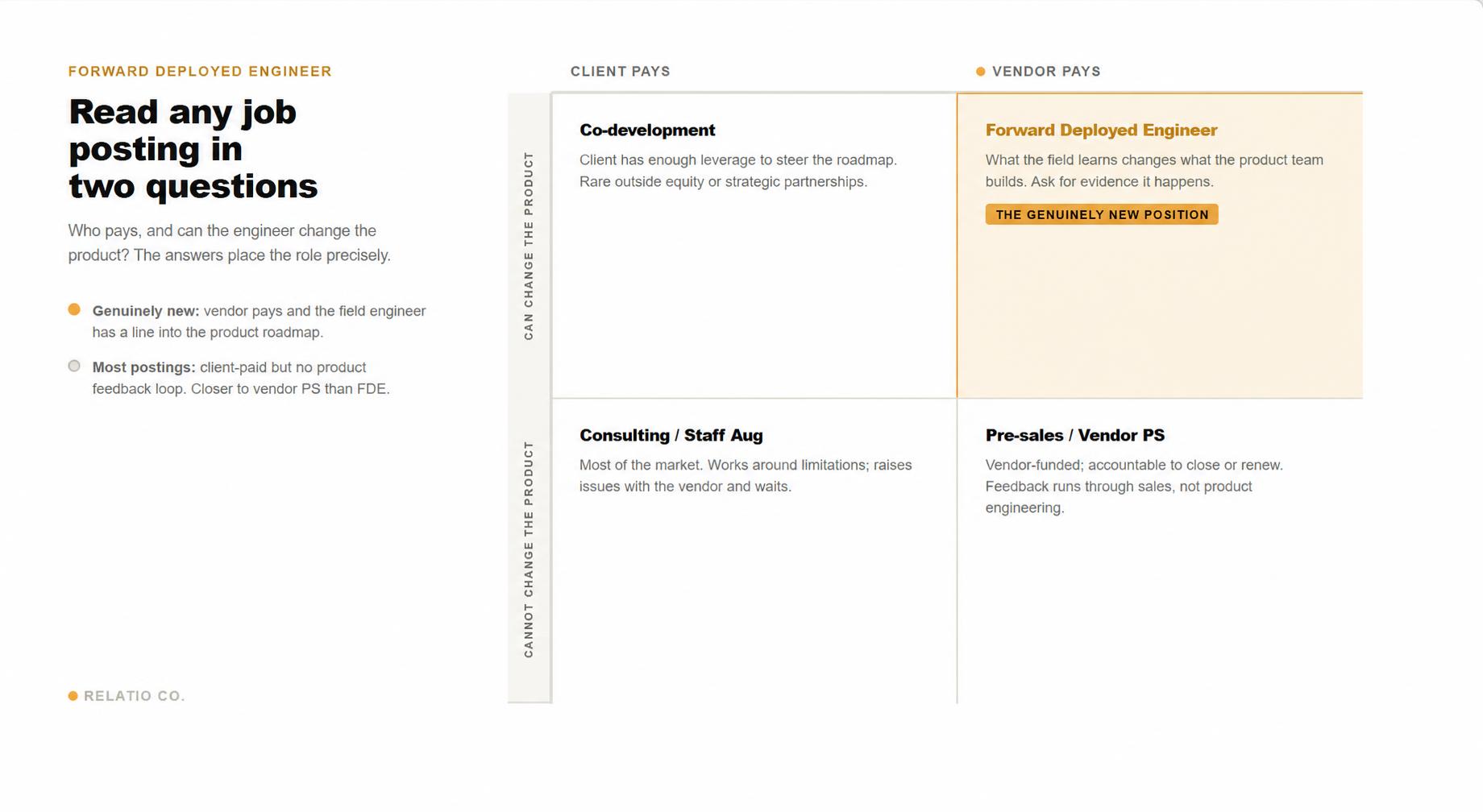
Two-by-two grid: who pays (client or vendor) against whether the engineer can change the product. Only vendor-paid with a line into the product is the genuinely new position.
This gives a simple way to read any job with the title. Ask whether the person can get the product changed, and ask who pays them. Where the answers are "no" and "the client, by the hour," the job is consulting, and there is nothing wrong with that.

We have seen the payer change before

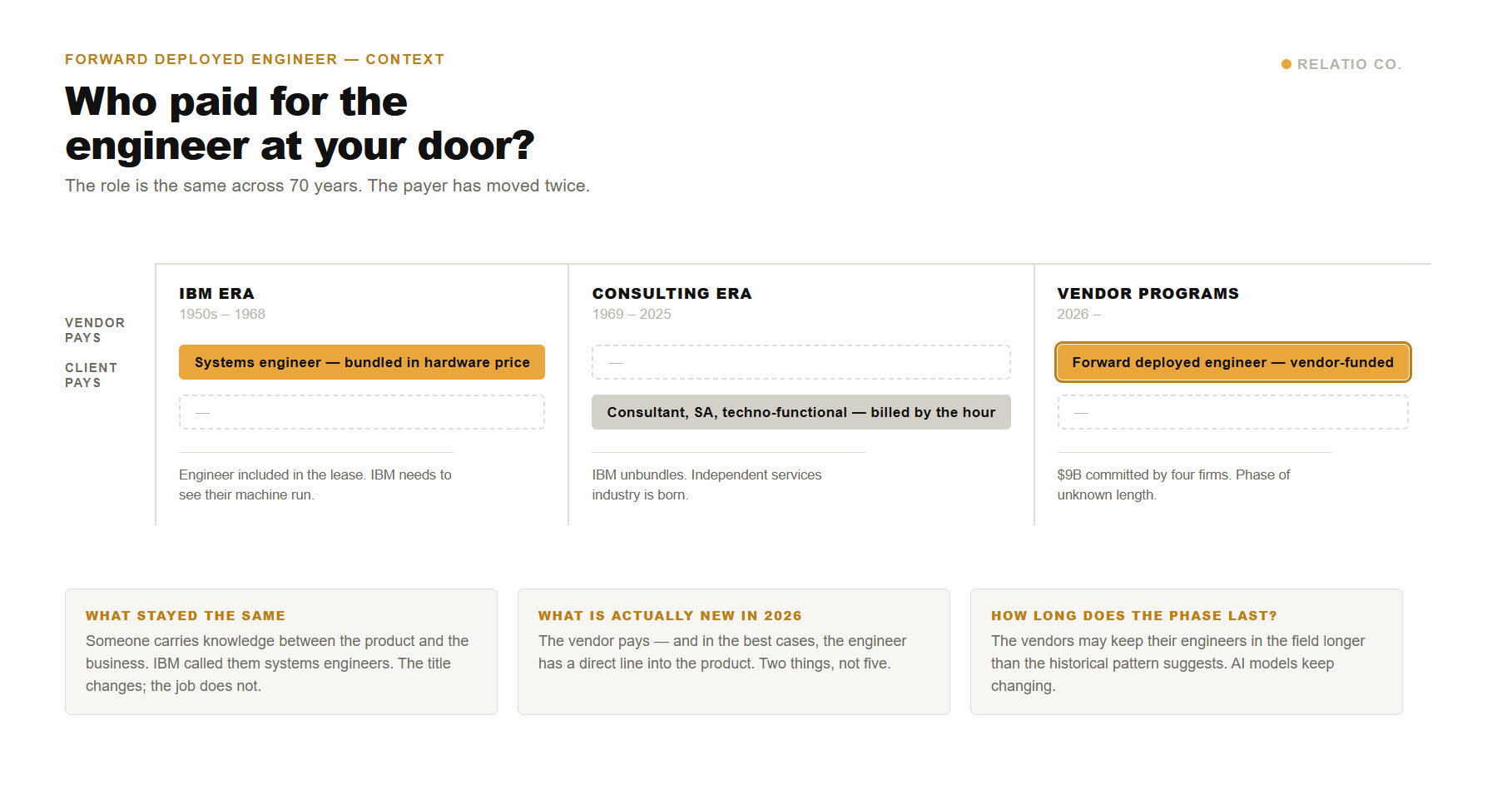
Through the 1960s, a customer who leased an IBM mainframe also got IBM's systems engineers. They worked at the customer's site, helped design the applications, and stayed until the machine was doing useful work. Their cost was included in the price of the hardware.
In June 1969, IBM announced it would charge separately for most systems engineering, for new programs, and for customer education. Historians of computing credit that decision with giving rise to the independent software and services industry. Once the work had its own price, other firms could compete for it.
Every consulting practice in enterprise technology descends from that separation. Seen from there, 2026 looks like the reverse movement. Vendors are again funding engineers at the customer's site as part of selling the platform.

Vendors include the engineer in the price while they need to, and stop when they no longer do. So what makes them need to?

Why vendors do the work themselves, for a while

Clayton Christensen and Michael Raynor gave one answer in The Innovator's Solution in 2003. While a technology is not yet good enough for what customers want from it, the companies that win tend to control the whole thing, because the parts depend on each other in ways that cannot yet be written down. Once the technology is more than good enough, clean interfaces appear, the work breaks into modules, and specialists take over the pieces.
Enterprise AI today fits the first description. Models change every few months, the tooling around them is unsettled, and few people can say in advance what a production deployment will need. A vendor that leaves deployment to others cannot see why deployments fail. Sending its own engineers is how it finds out.
If Christensen and Raynor are right, this is a phase. As the patterns stabilize, the vendor turns them into product and documented practice, and the remaining work moves to the channel. There are early signs. Microsoft announced Frontier Company together with partnerships with Accenture, Capgemini, EY, KPMG, and PwC. AWS designs its pods to leave customers self-sufficient.

Why the all-rounder was split up, and why that may reverse

The person who can run the workshop, design the solution, and build it has existed in consulting for a long time. Firms did not organize around that person, and David Maister's Managing the Professional Service Firm explains why. A firm earns its margin through leverage: a few senior people who find the work, more who manage it, and many junior people who do it. That shape rewards dividing work into pieces a junior specialist can be trained to deliver.
Maister also noted that leverage suits some work and not other work. Novel problems need a high share of senior time. Familiar, repeatable problems can carry a wide base of juniors. Enterprise software implementation spent thirty years moving from the first kind toward the second, and practices changed shape to match.
Fred Brooks described the opposite design in 1975. In "The Surgical Team," a chapter of The Mythical Man-Month, he set out Harlan Mills's proposal that one chief programmer should do the design and the critical work, supported by a copilot, a toolsmith, a tester, an editor, and a clerk. One mind keeps the design coherent, and communication stays cheap because there are few people to coordinate.
The idea saw limited use, partly because it was hard to find skilled people willing to take the supporting roles. That constraint is the one AI changes. An engineer working with coding agents has a toolsmith, a tester, and an editor on demand. The forward deployed engineer, in this reading, is Brooks's surgeon placed at the customer's site, with software filling most of the supporting team.

So, is it a fad?

  • The title probably is. It is already applied to consulting, staff augmentation, and pre-sales work, and its largest sponsor has started to distance itself from it. Titles that stretch this far tend to get replaced.
  • The function is permanent. Someone has to carry knowledge between the customer's business and the technology, and take responsibility for the result. IBM's systems engineers did it, techno-functional consultants did it, and these engineers do it now. Each generation of technology renames the job.
  • The vendor-funded version is a phase. It is tied to the period in which the product is immature. IBM ended its version when it could. Christensen and Raynor describe why vendors pull the work in and why they later let it go.

Three questions history cannot answer

  • How long the phase lasts. Mainframes took years to settle. If AI models keep changing as fast as they have, the product may stay "not yet good enough" for a long time, and vendors may keep their engineers in the field far longer than the pattern suggests.
  • Whether the line into product is real. It is the one new feature of the role, and the hardest to verify from outside. Microsoft's announcement stresses that customers keep what is built. No public account has described how what its 6,000 people learn reaches its product teams.
  • Whether the economics hold. The model needs more engineers for every new customer. Critics expect many of these programs to drift into consulting businesses. Search firm Christian & Timbers, which recruits for the role, mapped more than 17,000 forward deployed engineers in the United States and estimates that only about 2,000 consistently deliver measurable returns.

Three checks before you engage one

  • The line to the product team. A new title changes nothing a customer can feel. Ask, before the engagement starts, whether the engineer has a direct route to the people who build the product, and what has changed in the product because of it.
  • Commitments in writing. If the vendor presents the role as a differentiator, get it on paper: how long the engineer stays, what happens to the work when the engineer leaves, and who owns what is built. Vendors who have thought the model through will have answers.
  • An internal counterpart. As AI makes individual engineers more productive, the handoff between a vendor-funded engineer and your own team becomes the constraint. Pair the engineer with someone on your side who owns the knowledge transfer, the same practice that works for embedded consultants.

What this means in practice

The forward deployed engineer is mostly an old role in a new context. The two things that are genuinely new, a direct line into the product and a vendor paying for the placement, matter precisely because they are rare. Most roles carrying the title have neither. An engineer who has both sits in a structurally different position from a consultant, even when the daily work looks the same. Whether that position becomes a permanent part of the industry, or a phase that ends when the product matures, depends on how quickly AI platforms settle.

Sources

  1. 1
    Business Insider, May 2026. Indeed data on forward deployed engineer postings. Used for: 643 postings in April 2025 rising to 5,330 in April 2026, roughly 729% growth.

    https://www.businessinsider.com/forward-deployed-engineer-jobs-in-demand-2026-5

  2. 2
    Bloomberry (Henley Wing Chiu), November 2025. What I learned analyzing 1K forward deployed engineer jobs. Used for: 70% of postings mentioning equity and none carrying a quota.

    https://bloomberry.com/blog/i-analyzed-1000-forward-deployed-engineer-jobs-what-i-learned/

  3. 3
    PYMNTS, July 2026. AI giants pour billions into enterprise deployment. Used for: OpenAI's Deployment Company (more than $4 billion) and Anthropic's $1.5 billion venture.

    https://www.pymnts.com/news/artificial-intelligence/2026/ai-giants-spend-8-billion-dollars-fix-enterprise-adoption/

  4. 4
    TechCrunch, July 2, 2026. Microsoft launches its own AI deployment company with $2.5 billion commitment. Used for: Frontier Company's $2.5 billion, about 6,000 people, and Judson Althoff's statement.

    https://techcrunch.com/2026/07/02/microsoft-launches-its-own-ai-deployment-company-with-2-5-billion-commitment/

  5. 5
    CIO, July 2026. Microsoft and Amazon devote billions of dollars to thousands of FDEs. Used for: AWS's $1 billion commitment.

    https://www.cio.com/article/4192504/microsoft-and-amazon-devote-billions-of-dollars-to-thousands-of-fdes.html

  6. 6
    Times of India, July 2026. Used for: AWS pods embedded with a client for 45 days.

    https://timesofindia.indiatimes.com/technology/tech-news/openai-anthropic-amazon-and-now-microsoft-why-some-of-the-biggest-technology-companies-are-sending-thousands-of-their-employees-to-sit-in-customers-offices/articleshow/132155570.cms

  7. 7
    Christian & Timbers, September 2026. Hiring elite FDE talent. Used for: more than 17,000 mapped and about 2,000 meeting its standard.

    https://www.christianandtimbers.com/insights/how-to-hire-elite-forward-deployed-engineers

  8. 8
    Eric von Hippel, 1994. "Sticky Information" and the Locus of Problem Solving, Management Science 40(4). Used for: sticky information.

    https://doi.org/10.1287/mnsc.40.4.429

  9. 9
    IBM, June 1969. New IBM pricing policy (Computer History Museum archive). Used for: IBM charging separately for systems engineering, programs, and education.

    https://archive.computerhistory.org/resources/access/text/2014/06/102712825/102712825-05-01-acc.pdf

  10. 10
    Christensen and Raynor, 2003. The Innovator's Solution, chapter 5. Used for: integration while a product is not good enough, modularity once it is.

    https://www.hbs.edu/faculty/Pages/item.aspx?num=15473

  11. 11
    David Maister, 1993. Managing the Professional Service Firm. Used for: leverage and the senior/junior shape of a firm.

    https://www.simonandschuster.com/books/Managing-The-Professional-Service-Firm/David-H-Maister/9780684834313

  12. 12
    Fred Brooks, 1975. The Mythical Man-Month, "The Surgical Team." Used for: Harlan Mills's chief programmer proposal.

    https://en.wikipedia.org/wiki/The_Mythical_Man-Month

Start a conversation

One question, no obligation.

What are you trying to decide? If Relatio isn't the right fit, we'll say so.