← Evidence
Independence · Advisory
Are your technology decisions owned, or rented?
Most organizations own some of their technology decisions and rent the rest without noticing. Three questions show you which is which.
Trusted advisor5 min read
An insurance brokerage knew it needed a new CRM. What it didn't have yet was its own account of what that CRM had to do. So every vendor it spoke with offered to supply one.
Vendors know their products, and shaping a buyer's thinking is part of selling. It also left the brokerage as the only party at the table with nothing to sell.
That's what we mean by a rented decision. It doesn't feel rented at the start. You still sign the contract and answer for the outcome.
What you don't own is the thinking underneath it: the requirements, and the picture of what good looks like. The rent comes due later, in delivery and after go-live.
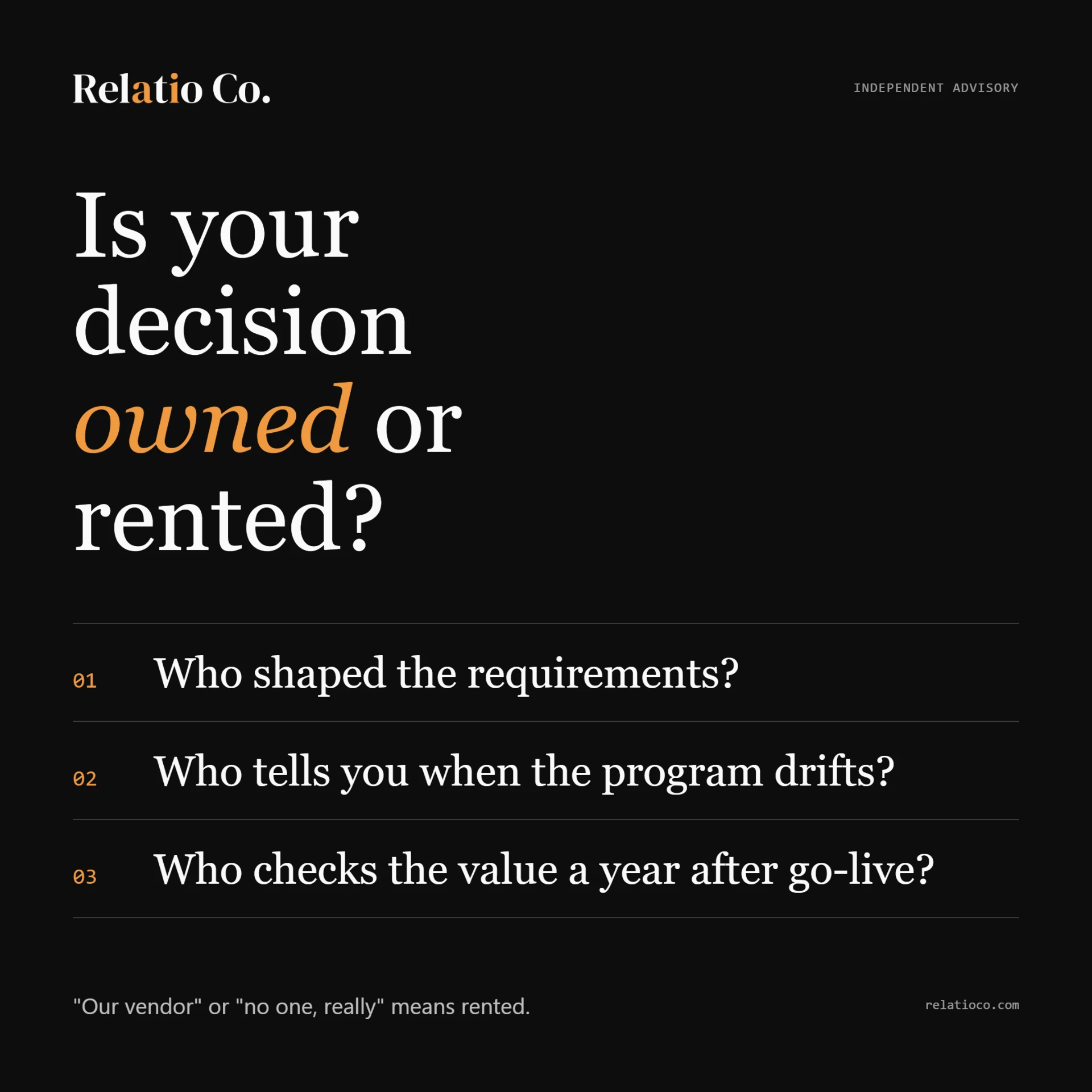
Three questions
You can tell an owned decision from a rented one by asking who does three jobs.
01. Who shaped the requirements?
If the honest answer is the vendor or the implementer, the shortlist was settled before anyone made it. And buyers lean on sellers more than they may think: in a 2025 Gartner survey of 645 B2B buyers, 69% said they check their AI-generated research with a sales rep.
Owning this moment means requirements that come from how your business actually runs, written in a form every bidder has to answer on the same terms.
That's what the brokerage did. It defined its requirements, turned them into an RFP and an evaluation framework, and chose a platform. Then it used the same material to choose the firm that would implement it.
02. Who tells you when it drifts?
Programs drift. In PMI's 2018 Pulse of the Profession, 52% of projects completed in the prior year had scope creep. Usually the sponsor hears about it at the steering committee instead of in the hallway.
Good delivery teams are built to ship. Saying the build has drifted from the decision is a hard call for anyone whose milestone depends on it. That's how the work is set up, and an independent view helps the client and the partner alike.
Owning delivery means someone in the room whose job is to hold the build up against the decision and say plainly when the two have parted. On a 16-month rollout at a mid-sized global manufacturer, that was our role: delivery oversight from the client side, so leadership had an independent view the whole way through. When we see drift, we raise it early, with the client's sponsor and the partner together.
03. Who checks the value a year on?
Go-live is usually where measurement stops. The business case gets filed and no one asks whether the system is earning its keep.
The gap is large. McKinsey and the University of Oxford studied more than 5,400 IT projects and found that large ones delivered 56% less value than predicted. Owning what you've built means knowing what's working and who's responsible for each piece.
That now includes what your own teams build. AI makes it easy for anyone to create an app or an agent, which is mostly good news. People aren't waiting for permission, either: in Microsoft and LinkedIn's 2024 survey of 31,000 workers, 78% of AI users brought their own AI tools to work.
A national distributor we worked with had warehouse teams building their own automation. We helped give that work owners and controls, and the teams kept building without turning every improvement into an IT project.
If the honest answer to any of the three is "our vendor" or "no one, really," that decision is rented.
Three questions are a quick read. For a fuller one, the Ownership Check takes 3 minutes, needs no sign-up, and shows where your decisions are owned and where they're rented.
Where independent advice fits
An independent advisor is one way to own all three. Ours sits on your side of the table.
We charge a fixed fee, agreed in writing before work begins, and we make no money from implementation services. The fee is the same whichever platform, partner, or path you choose, including the choice to wait. At the brokerage, it was less than 1% of the program.
We're AI-native in how we work. AI does the volume work; a practitioner makes the call and puts their name on it. That's how a small senior team can go deep without an enterprise-sized bill.
Some partners offer the decision work too, like assessments and roadmaps. Our view is that the firm that helps you decide shouldn't also be bidding to build. Once the decision is made, we're on the same side as whoever builds it.
The best partners we work with want this. A customer who owns its decision writes a clearer brief and chooses faster. Scope is settled before the proposal is written, and go-live is where the value starts.
Some of the best advice we've given was to pause, or to wait until the organization was ready. That advice is hard to give honestly when the next line on your P&L depends on the project going ahead.
The brokerage finished with a strategy, an RFP, an evaluation framework, and a roadmap it owned outright. The decision was theirs from the first requirement to the choice of partner. Read the full case.
Sources
- 1Gartner, survey of 645 B2B buyers, Aug to Sep 2025, published May 20, 2026.
- 2PMI, Pulse of the Profession 2018, via "Scope Patrol."
https://www.pmi.org/learning/library/scope-creep-rising-11308
- 3McKinsey & Company with the University of Oxford, "Delivering large-scale IT projects on time, on budget, and on value," 2012. Large projects: budgets over $15M.
- 4Microsoft and LinkedIn, 2024 Work Trend Index, 31,000 people in 31 countries.
- 5Relatio Co. case studies and Partners page.